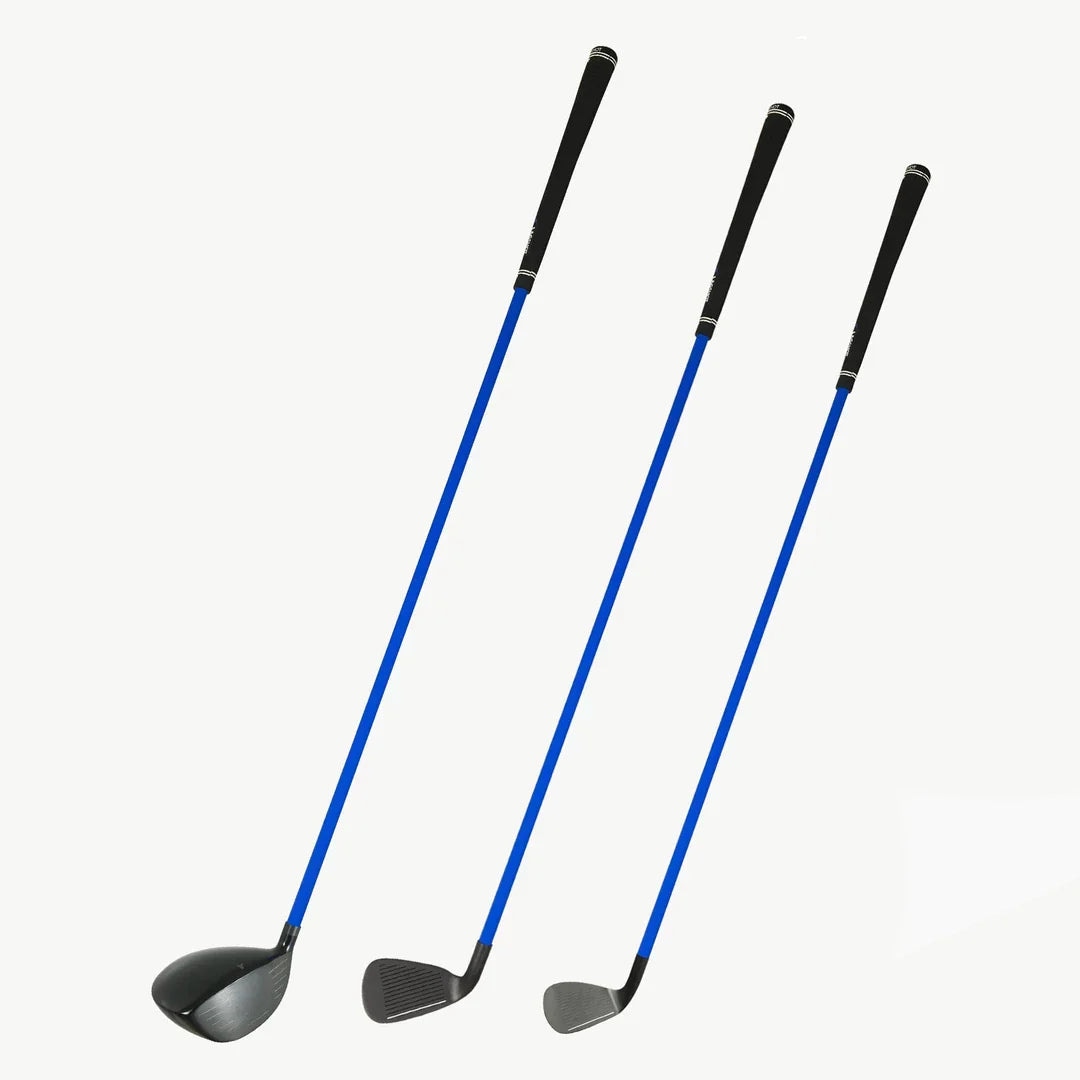


Lag Shot Golf builds its catalog around a specific training idea: a golf club with a deliberately flexible shaft can make timing and sequencing errors easier to feel. Instead of selling a broad mix of mats, nets, alignment sticks and electronics, the brand applies that concept to drivers, irons, wedges, putters and age- or size-specific trainers.
That focus makes Lag Shot easy to describe but less simple to shop. The right model depends on the part of the game being practiced, the golfer's size and handedness, and whether one trainer or a multi-club system makes sense. This research-based Brand Review examines the range, explains what flexible-shaft feedback can and cannot do, and separates the company's intended benefits from independently verified outcomes.
What Is Lag Shot Golf?
Lag Shot Golf is a golf training-aid brand founded after Gary Guerrero developed the original concept in 2019, according to the company's published brand story. Its signature products resemble playable golf clubs but use conspicuously flexible shafts. The brand says that this design helps golfers feel a smoother transition, tempo and sequence while making swings or hitting balls.
The important word is “feel.” Lag Shot does not physically lock the golfer into one path or provide launch-monitor measurements. The shaft bends in response to how the club changes direction, so an abrupt transition can produce a more obvious sensation than it would with a conventional shaft. Interpreting that feedback still requires judgment, instruction or both.
Lag Shot's public pages make strong claims about distance, accuracy and lower scores. Those claims express the manufacturer's intended outcomes. CouponHomeSquad has not independently tested the products, measured swing changes or verified that a given user will achieve those results.
How the Lag Shot Training Concept Works
A normal golf shaft also flexes, but Lag Shot exaggerates that movement. When the hands and body move out of sequence, the training shaft can feel unstable or make centered contact more difficult. A smoother takeaway and transition give the golfer a different reference point for how the club loads and returns.
This creates two types of feedback. The first is tactile: the golfer feels the shaft and clubhead lag behind a rushed movement. The second is ball-flight feedback, because Lag Shot markets many of its trainers as clubs that can hit real balls. Contact and direction can show whether the motion produced a functional strike.
Neither form of feedback is a complete diagnosis. A poor shot can come from grip, alignment, face angle, swing path, low-point control or physical limitations as well as tempo. The brand includes or promotes instructional videos with many products, and that context is useful. Golfers who cannot identify why contact changes may still benefit from a qualified coach.
What Does Lag Shot Golf Sell?
The current official catalog spans individual swing trainers, putting trainers, two- and three-club combinations, and products sized or configured for different golfers. The core adult range includes driver, 7 iron, wedge and putter trainers. Combo sets group several of those tools for practice across multiple shot types.
Lag Shot also presents women's, XL, junior and very young-child lines. Those are meaningful distinctions rather than color changes alone: the official product descriptions refer to differences in length, weight, grip and shaft flexibility for certain age- or size-specific models. Buyers should therefore select the intended line rather than assume every blue-shaft trainer has the same dimensions.
The catalog is organized around who is practicing and what part of the game needs attention. That structure is more useful than trying to rank one model as the universal choice.
Drivers, Irons and Wedges
The driver trainer targets the longest full swing and the transition into the downswing. Lag Shot positions it for tempo, sequencing and tee-shot practice. Its greater length makes it more demanding than an iron trainer, so golfers new to flexible-shaft work may find it easier to begin with controlled speed.
The 7 iron is the brand's central full-swing format. A mid-iron length is familiar to many golfers and supports range practice without the additional length of a driver. It can be a practical first Lag Shot for someone whose main goal is to explore tempo and centered iron contact.
The wedge trainer brings the same feedback principle into shorter scoring shots. Wedge practice involves varied swing lengths and distance control, so the model serves a different purpose from simply owning another full-swing club. Golfers should still calibrate carry distances with their normal wedges because a training club's shaft behavior and ball flight are not a substitute for on-course yardage work.
Choosing among these formats starts with the recurring problem. A golfer who rushes tee shots but is comfortable with irons may only need the driver. Someone whose tempo changes throughout the bag may benefit from a combination. The widest set is not automatically the best value if some components stay unused.
Putting Trainers
Lag Shot also applies a flexible-shaft concept to putting. The official putter page describes a weighted head and hyper-flexible shaft intended to provide feedback about tempo and touch. That is a distinct practice task from generating lag in a full swing, and buyers should evaluate it as a putting aid rather than assume the driver or iron logic transfers unchanged.
A flexible putter can make an abrupt stroke easier to notice, especially during distance-control practice. It cannot read greens, establish aim or guarantee face control. Golfers primarily struggling with start line may need alignment feedback, while those struggling with speed may find tempo-oriented work more relevant.
Men's, Women's and XL Options
Lag Shot's storefront separates men's and women's trainers and also lists XL versions. The XL line is presented for larger or taller golfers, while women's models are positioned around a different target user. Exact specifications and availability vary by product, so the label should be treated as a starting point rather than a fitting result.
Before ordering, compare the model's stated length, handedness and intended user with current equipment and physical needs. A golfer who has been professionally fitted should not assume a training club matches the lie, length, grip or swing weight of the playing set. If those details are important, confirm them directly with Lag Shot.
Left-handed golfers have options across portions of the range; the official FAQ specifically states that left-handed versions are available. Availability should be checked on the exact product page because not every configuration is necessarily offered in every line.
Junior and Early-Age Trainers
The official catalog includes junior products for multiple age ranges as well as “Baby” and “Babygurl” trainers for very young children. Lag Shot says its junior designs use age-appropriate changes such as shorter length, lower weight, smaller grips and different flexibility.
Those distinctions matter because an adult training club can be too long or heavy for a child. Shoppers should choose by the exact age/size guidance published for the model and check that the child can swing safely in the available space. Marketing statements about improvement should not replace age-appropriate instruction, supervision or enjoyment.
For families, the value of a junior trainer depends on fit and interest. A correctly sized tool that supports playful practice may be useful; a product bought solely for future growth can undermine the feedback if the current dimensions are unsuitable.
Combo Sets and Building a Practice System
Lag Shot sells two-club, three-club and broader family or full-game combinations. These packages can make sense when a golfer wants a consistent feedback concept across tee shots, iron play and the short game. They also require more storage, more practice time and a clearer plan than one club.
A useful combo routine should have progression. The golfer might begin with shorter controlled motions, advance to the 7 iron, then move to the driver while preserving the same tempo cue. Another session might alternate a trainer with the corresponding conventional club to test transfer. Simply swinging every trainer at maximum speed gives the shaft movement plenty of drama but not necessarily useful learning.
The Triple Threat deal supplied by the owner is one example in the range, but this is a Brand Review rather than a Product Review. Its presence demonstrates how Lag Shot packages driver, iron and wedge practice; detailed evaluation of that exact set belongs in its separate Product Review.
Instruction and Practice Guidance
Many official product pages pair the physical trainer with video lessons or drills. This is an important part of the proposition because exaggerated feedback without an explanation can be misread. The brand's FAQ and instructional copy emphasize smooth transition, tempo and sequence.
Golfers can make practice more useful by defining one goal per session, beginning below full speed and monitoring balance and contact. If the trainer produces worse strikes, the answer is not always more force. Slow rehearsal, video from a consistent angle or coaching can help connect the sensation to actual movement.
Transfer should be deliberate. Alternating between the trainer and an ordinary club is more informative than completing an entire session with only the flexible shaft. The golfer can then assess whether the cue survives when the exaggerated feedback disappears.
What Stands Out About Lag Shot Golf?
The brand's main strength is focus. Its catalog does not scatter attention across unrelated gadgets; it develops one feedback concept across different clubs and golfer profiles. That gives buyers a logical path from a single 7 iron to a broader training system.
The range also supports real-ball practice. That can make the aid more engaging than rehearsal-only tools and lets the golfer see contact and flight. The result still requires careful interpretation, but it adds information beyond how the shaft feels.
Finally, the age- and size-specific lines show that Lag Shot does not treat one adult club as suitable for everyone. Women's, XL, junior and early-age models expand access, although exact fit must still be confirmed on the individual listing.
Things to Consider Before Buying
Start with the actual practice problem. Tempo and transition tools are relevant when the golfer rushes the change of direction, loses sequence or wants a repeatable rhythm. They are less direct for green reading, static alignment, equipment gapping or data-driven face/path analysis.
Next, decide whether one club or a combo is justified. One trainer costs less, occupies less space and can keep practice focused. A combination provides broader coverage but only delivers value when its components are used. Handedness and model family also need confirmation.
Finally, consider how feedback will be evaluated. Golfers who prefer numbers may want a launch monitor or swing sensor alongside a feel-based tool. Anyone with an injury or movement restriction should get appropriate professional advice before introducing a highly flexible full-size club.
Pricing and Value
Lag Shot's range spans individual trainers and multi-club bundles, so value depends on scope rather than the lowest displayed price. An individual trainer may be sufficient for one recurring problem. A combo can reduce duplication and provide consistent feedback across more of the bag, but unused clubs make the package less economical.
Current storefront pricing and promotional banners can change. This review does not import researched promotions. The only commercial offers presented in Ways to Save are the exact coupon and deal supplied by the owner.
Shipping, Returns and Support
Lag Shot's official FAQ says orders generally take one to four business days to process. It gives a typical United States delivery estimate of four to seven business days and says international shipping is available, with cost and timing depending on destination. Buyers should rely on the live checkout and order confirmation because fulfillment messages can change by product.
The current refund policy publishes a 30-day trial or return period from receipt. Customers must contact Lag Shot for instructions, and returned products are inspected before refunds are approved. The policy says ordinary return shipping is the customer's responsibility. Defective or damaged exchanges have separate handling. The policy therefore should not be summarized as universally free returns.
Support is available through the contact channels published by Lag Shot. Buyers concerned about fit, handedness or a particular model's specifications should ask before ordering rather than infer details from another trainer.
Who May Find Lag Shot Golf Worth Considering?
Lag Shot may suit golfers who respond well to feel-based feedback and want to work specifically on tempo, transition and sequence. Range users who enjoy hitting balls with a training aid may prefer the club format to a rehearsal-only device.
The catalog is also relevant to households seeking more specific sizing choices, including left-handed, women's, XL and junior options. Golfers working with a coach can use the trainer as one cue within a broader improvement plan.
Combo systems may appeal to players whose rhythm changes between driver, iron and wedge swings. Single-club options are more appropriate when one area clearly needs attention.
Who May Want to Look Elsewhere?
Golfers who want objective club-path, face-angle or speed measurements should consider a sensor or launch monitor. Players needing help with alignment, putting start line or course management may benefit from a tool designed specifically for those tasks.
Someone who dislikes exaggerated flexible-shaft feel or has little time for structured practice may not get enough value from the system. Buyers who require exact custom-fit specifications should confirm availability before purchase, as the brand's general marketing pages do not provide a complete fitting matrix for every model.
Golfers expecting an automatic distance increase should reset that expectation. Lag Shot can provide feedback, but results depend on practice, interpretation, physical capability and transfer to normal clubs.
Ways to Save
The owner supplied coupon the supplied coupon - 55% OFF and the deal Triple Threat - $387 → $299 (~23% OFF). No expiration, minimum spend, eligible-product rule or stacking condition was supplied. Verify current checkout eligibility and do not assume the coupon combines with the deal.
Pros
- Focused flexible-shaft training concept across driver, iron, wedge and putter formats
- Single-club and multi-club options support different practice scopes
- Women’s, XL, junior and early-age lines expand sizing choices
- Left-handed configurations are available for parts of the range
- Many trainers are designed for practice with real golf balls and include instructional content
Cons
- Flexible-shaft feedback does not diagnose every cause of a poor golf shot
- Large catalog requires careful selection by user, size and practice goal
- General pages do not provide a complete fitting matrix for every model
- Multi-club bundles require more storage, time and practice commitment
- Distance and consistency claims rely on manufacturer positioning rather than CouponHomeSquad testing
Final Verdict
Lag Shot Golf offers a clear, coherent training system built around exaggerated flexible-shaft feedback. Its driver, iron, wedge and putter formats let golfers target different swing lengths, while women's, XL and junior lines broaden the range beyond a single adult specification. The ability to hit balls and access instructional material makes the concept more practical than a purely passive aid.
The same focus creates limits. Flexible-shaft feel does not diagnose every swing fault, produce objective measurements or guarantee distance and accuracy gains. Buyers should start with a specific practice problem, choose the correct size and handedness, and decide whether one trainer or a combo will actually be used.
Lag Shot is most compelling for golfers who value tactile feedback and are willing to practice deliberately. It is less suitable for shoppers looking for an automated fix or measurement-first coaching system. The brand makes the most sense when its tools support a defined practice plan rather than substitute for one.
FAQ
What does Lag Shot Golf sell?
Lag Shot sells flexible-shaft golf swing trainers in driver, iron, wedge and putter formats, plus combo sets and lines intended for women, taller golfers, juniors and very young children.
How is a Lag Shot trainer supposed to help?
The flexible shaft exaggerates timing and sequencing feedback. Lag Shot says it encourages a smoother transition and tempo. This review has not independently verified performance gains, and the feedback may require instruction to interpret correctly.
Can golfers hit real balls with Lag Shot trainers?
Lag Shot markets many of its training clubs for real-ball practice. Buyers should follow the exact model's instructions and use a safe range, net or practice area.
Should I buy one trainer or a combo set?
Choose one trainer when a single part of the game is the priority. A combo is more useful when the golfer wants the same feedback concept across multiple swing lengths and will practice with every included club.
Does Lag Shot offer left-handed models?
The official FAQ says left-handed options are available. Confirm the exact configuration on the product page before ordering because availability varies.
Does Lag Shot make trainers for juniors?
Yes. The official catalog includes junior and early-age lines. Product descriptions identify differences such as length, weight, grip size and flexibility for particular groups, so use the exact model's sizing guidance.
Is Lag Shot a substitute for golf lessons?
No. It is a feedback tool. A coach can help determine whether tempo is the real issue and connect the shaft sensation to grip, setup, path, face control and contact.
What return period does Lag Shot publish?
Lag Shot currently publishes a 30-day period from receipt. Its policy says customers pay ordinary return shipping and returned products are inspected before refund approval.
Explore Lag Shot Golf training formats through the Store CTA while preserving the owner-supplied affiliate destination.