

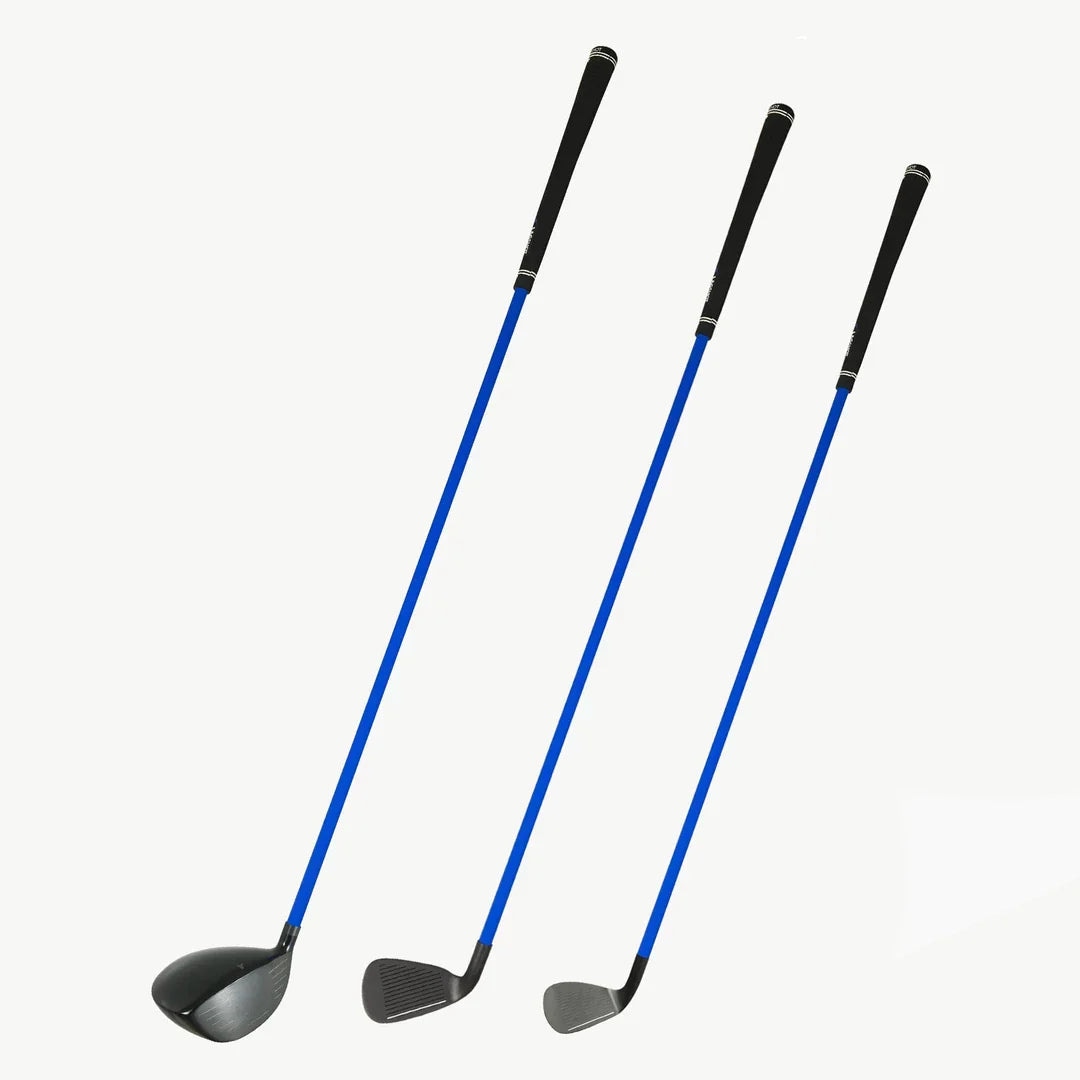
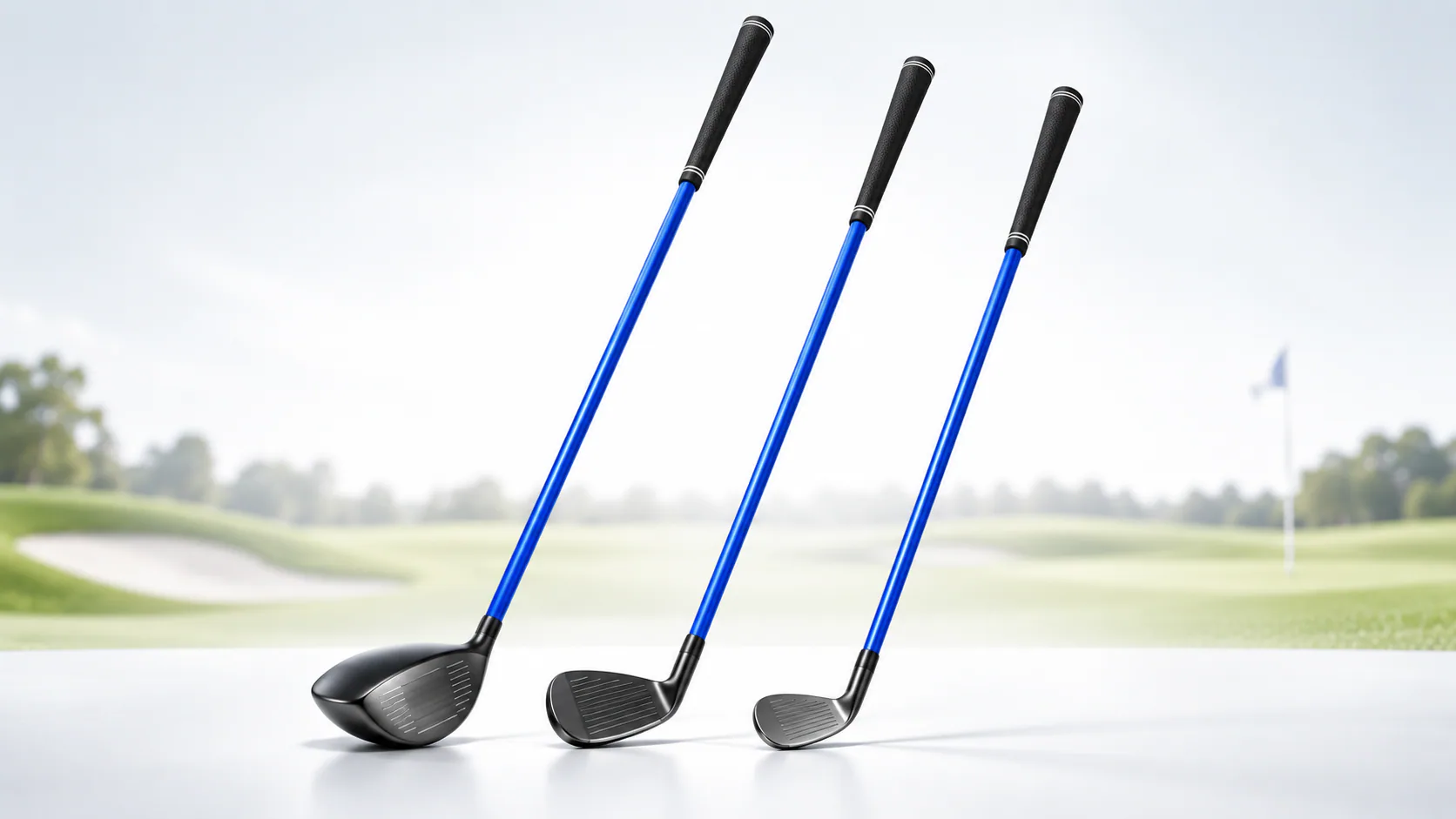
The Lag Shot Triple Threat is a coordinated set of three golf swing trainers: a driver, a 7 iron and a wedge. Each uses the brand's flexible blue training shaft, but each is intended to move the same tempo and sequencing work into a different part of the bag. The driver addresses tee-shot motion, the 7 iron covers full iron swings, and the wedge brings the concept into shorter scoring shots.
That broader coverage is the main reason to consider the set instead of one Lag Shot club. It also makes the purchase more demanding. A golfer needs a repeatable practice plan, space to swing three full-size clubs and realistic expectations about what a feedback tool can accomplish. This review is based on Lag Shot's current product information and policies; it does not claim hands-on testing or guarantee a swing change.
Quick Verdict
Triple Threat is best understood as a three-part tempo and sequencing system, not a replacement set of playing clubs and not an automatic distance fix. The flexible shafts provide visible and tactile feedback when the transition becomes abrupt or the club falls out of sequence. Including a driver, 7 iron and wedge lets a golfer work on a related motion from tee to green rather than assuming a drill with one club will transfer perfectly to every shot.
The set makes the most sense for golfers who will practice regularly and want the same training concept across three distinct swing lengths. Someone who only wants help with one part of the game may get better value from a single trainer. The manufacturer makes strong claims about added distance and improved consistency, but actual results depend on the golfer, instruction quality and practice.
Product Overview
Lag Shot's official Triple Threat page identifies the exact set as a Driver, 7 Iron and Wedge combo. The clubs use the brand's flexible “whippy” shaft and black clubheads, and the page offers right-handed and left-handed configurations. The current package also lists an online video course, a transition drill and an impact lesson as included instructional material.
The Product Category is Golf Swing Trainer Set. These clubs are designed to exaggerate timing errors and help the user feel a smoother sequence. Although the product page encourages golfers to hit balls with them, their primary role is practice and feedback. Buyers should not assume the shaft behavior, ball flight or feel will match a fitted set of conventional clubs.
What Comes in the Triple Threat Set?
Driver trainer
The driver trainer is the tee-shot component. Lag Shot positions it as a way to discourage a rushed transition and develop the sequence associated with lag and a more centered strike. A flexible trainer can make an abrupt change of direction easier to notice because the clubhead and shaft do not immediately follow the hands.
That feedback does not prove a golfer will add the manufacturer's advertised distance. It may help identify a tempo problem, but launch conditions, club delivery, strike location, speed and equipment fit still determine real driving performance.
7 iron trainer
The 7 iron sits in the middle of the set and is the most natural starting point for many full-swing drills. Lag Shot describes it as a tool for tempo, timing and on-plane motion. Compared with the driver, its shorter length can make it easier to begin with controlled swings before progressing to longer motion.
The value of the 7 iron is its connection to ordinary range practice. It provides a reference for a representative iron swing without requiring the golfer to move immediately between every club in the bag. The feedback still needs interpretation: a poor shot can come from setup, face control, contact or path as well as tempo.
Wedge trainer
The wedge extends the system into shorter shots. Lag Shot says it is intended for rhythm, contact and distance-control practice around the green. Wedge motion differs from a driver swing in length and intent, so a dedicated trainer can help the golfer explore how the same smooth transition feels in chips, pitches and controlled full swings.
This is also the component that requires the most restraint. Distance control depends on predictable carry, strike and technique. The trainer can support rehearsal, but golfers should calibrate real on-course distances with their playing wedges rather than treating the training club's yardage as transferable.
How the Flexible-Shaft Feedback Works
The Triple Threat concept relies on a shaft that bends more noticeably than a normal playing shaft. When the hands start down too aggressively or the club changes direction out of sequence, the flexible shaft can feel unstable and make centered contact harder. A smoother motion gives the shaft more time to load and recover.
This makes the product a feedback device rather than a mechanical guide. It does not lock the club onto one plane, control the face or physically force a correct impact position. Two golfers can feel the same shaft response for different reasons. Pairing the feedback with the included instruction—or with a qualified coach who can see the actual motion—reduces the risk of practicing the wrong correction.
Lag Shot attributes distance, accuracy and consistency benefits to the system. Those statements describe the manufacturer's intended outcome. CouponHomeSquad has not independently measured clubhead speed, carry distance, dispersion or swing-plane changes with this set.
Practice Structure and Learning Curve
A sensible first session should prioritize control over speed. Begin with shorter swings using the 7 iron or wedge, notice how the shaft responds during the transition, and build toward a balanced finish. The purpose is to recognize timing, not to overpower the flexible shaft. Full-speed driver swings are more useful after the golfer can repeat a smooth motion with the shorter clubs.
The three-club format also supports progression. A golfer can work from wedge to iron to driver and observe whether the same sequencing cue survives as the shaft gets longer and the swing becomes faster. Alternatively, practice can focus on the weakest area without using all three clubs every session.
What the set does not provide is diagnosis. If contact worsens or the golfer is unsure what the shaft is signaling, repeatedly hitting more balls may reinforce confusion. The included videos add context, but personalized instruction may still be valuable for persistent path, face or setup issues.
Design and Configuration Considerations
The official page offers right-handed and left-handed versions, so handedness must be selected carefully at checkout. The current listing describes blue flexible shafts and black clubheads across the combo. It does not present the set as custom-fit equipment, and the page does not publish a full fitting matrix for length, lie, loft, shaft weight or grip size.
That matters for unusually tall or short golfers and for players with physical limitations. The standard combo may not mirror a golfer's fitted clubs. Lag Shot also sells other variants elsewhere in its catalog, including XL, women's and junior trainers, but those are different products and should not be assumed to be included in this exact Triple Threat listing.
Storage and practice space deserve attention as well. This is a three-club package, not a compact resistance band or pocket aid. Indoor use requires enough ceiling height and clearance for the selected club and drill. Hitting real balls indoors also requires an appropriate net, mat and safety setup.
What Stands Out
The strongest feature is coverage. Many swing aids isolate one motion or one club. Triple Threat applies a consistent feedback idea to tee shots, iron shots and wedge work. That can make practice more coherent for a golfer whose transition changes as shot length changes.
The set also combines physical feedback with structured instruction. The official package lists a video course, a transition drill and an impact lesson. Those materials can give the user a starting sequence instead of leaving the flexible shaft entirely open to interpretation.
Finally, the clubs can be used while hitting balls according to Lag Shot's product guidance. Seeing the resulting strike and flight adds information that a rehearsal-only aid cannot provide. Ball flight should still be treated as practice feedback rather than proof that the user's ordinary clubs will produce identical results.
Important Limitations
The first limitation is specificity. If the golfer's main issue is putting, green reading, alignment or equipment fit, this three-club swing trainer is not designed to solve it. Even within the full swing, face control and contact can require work beyond tempo.
The second limitation is the need for interpretation. A flexible shaft amplifies timing feedback, but it does not explain the root cause of every poor strike. Golfers who prefer a rigid, measurement-led system may want launch-monitor data or coaching alongside the set.
The third limitation is transfer. Smooth swings with the trainers are useful only if the golfer can reproduce the relevant sequence with conventional clubs. Practice should include alternating between a Lag Shot trainer and the corresponding playing club rather than assuming transfer will happen automatically.
Who Is the Triple Threat Best For?
The set is most relevant to golfers who recognize tempo or transition as a recurring problem and want one training approach across driver, iron and wedge practice. It can also suit players who enjoy range sessions and respond well to feel-based feedback.
Golfers rebuilding a rushed downswing may appreciate the exaggerated shaft response. Players who struggle to carry one rhythm from full swings into shorter scoring shots may value having both a 7 iron and wedge trainer. Left-handed availability is useful for golfers who are often excluded from training-aid configurations.
It may also suit a golfer working with an instructor who wants a flexible-shaft aid as part of a broader plan. In that situation, the coach can connect the sensation to observable changes rather than leaving the golfer to diagnose the motion alone.
Who Should Consider Another Option?
A beginner who needs fundamentals such as grip, posture and alignment may get more value from instruction before buying three trainers. A golfer with only one narrow problem may prefer a single Lag Shot club or a different targeted aid. Players who want objective speed, path or face measurements should consider a launch monitor or sensor-based system.
The set may also be excessive for someone with limited storage, limited practice space or little time for regular sessions. Golfers who need custom fitting dimensions should verify them directly with Lag Shot before ordering. Anyone managing an injury should seek appropriate professional guidance before using an unfamiliar flexible-shaft training club.
Price and Owner-Supplied Deal
The owner-supplied deal lists the Triple Threat at an original price of $387 and a deal price of $299, described as approximately 23% off. The official product page displayed the same two price points when researched, but the OwnerFact remains the controlling commercial record for this review.
The package price should be evaluated against intended use. It includes three trainers and the listed instructional bonuses, so it is more comprehensive than buying one tempo aid. It is less compelling if only one club would be used consistently. Compare the cost with single-club options, coaching and measurement tools according to the actual practice goal.
The owner also supplied coupon code the supplied coupon for 55% off. No expiration, eligible products, minimum spend or stacking terms were supplied. Do not assume the coupon combines with the listed deal; confirm current checkout eligibility before relying on it.
Shipping, Trial and Returns
Lag Shot's official FAQ says orders generally require one to four business days for processing and that delivery timing depends on destination. The exact product page may show current fulfillment or preorder messaging, so buyers should read the live status at checkout rather than relying on a static estimate.
Lag Shot publishes a 30-day trial or return period measured from receipt. Its refund policy says customers should contact support for return instructions, returned clubs are inspected, and refunds go to the original payment method after approval. Customers are responsible for return shipping on ordinary returns; defective or damaged exchanges follow a separate process. This should not be summarized as universally free returns.
Pros
- Three trainers cover driver, full-iron and wedge practice within one feedback system
- Flexible shafts make tempo and transition errors easier to feel
- Right-handed and left-handed configurations are listed
- Instructional video and drill content are included with the official package
- The clubs are designed for practice with real golf balls
Cons
- Three full-size trainers require more storage and practice commitment than a single aid
- Flexible-shaft feedback does not diagnose every cause of poor contact
- No full custom-fitting matrix is published on the exact product page
- Manufacturer distance and consistency claims are not independent test results
- Training gains still have to transfer back to conventional playing clubs
Final Verdict
The Lag Shot Triple Threat offers a coherent way to work on tempo and sequencing across three important parts of the game. The driver, 7 iron and wedge are not redundant: they let the golfer test whether a smoother transition can be maintained as swing length and shot intent change. The included instructional material gives the system more direction than a flexible club sold without a practice framework.
Its value depends on use. A motivated golfer who practices regularly and understands the feedback may benefit from having all three trainers. A player with one isolated need, limited practice time or a preference for measured data may be better served by a single trainer, coaching or a sensor-based tool. Manufacturer claims about distance and consistency should be treated as intended outcomes rather than guaranteed results.
For the right golfer, Triple Threat is a substantial practice system. The best buying decision comes from confirming handedness and fit, deciding whether all three clubs will be used, and planning how the training motion will be transferred back to normal equipment.
FAQ
What clubs are included in the Lag Shot Triple Threat?
The exact official product page lists a Lag Shot Driver, 7 Iron and Wedge. It also lists instructional video and drill content as package bonuses.
Is Triple Threat a set of normal playing clubs?
It is sold as a golf swing training set built around flexible-shaft feedback. Lag Shot says the clubs can be used to hit balls, but buyers should treat them as training tools rather than assume they match the specifications or behavior of fitted playing clubs.
Does it come in left-handed and right-handed versions?
Yes. The official listing offers right-handed and left-handed configurations. Confirm the selected option before checkout.
How is the driver different from the 7 iron and wedge trainers?
The driver applies the tempo concept to the longer tee-shot motion, the 7 iron supports representative full iron swings, and the wedge brings the feedback into shorter scoring shots. This lets golfers practice related sequencing across different swing lengths.
Will the Triple Threat automatically add distance?
No outcome is guaranteed. Lag Shot promotes distance and consistency benefits, but this review has not independently tested them. Results depend on the golfer's starting motion, practice, instruction, strike and ability to transfer the feel to conventional clubs.
Can beginners use the set?
Beginners can use a tempo trainer, but they may need instruction to distinguish timing feedback from grip, setup, face-control or path problems. Starting with controlled swings and clear guidance is more useful than immediately swinging at maximum speed.
What is the owner-supplied Triple Threat deal?
The supplied deal is $387 reduced to $299, approximately 23% off. A separate owner-supplied coupon exists, but no stacking or eligibility conditions were provided, so checkout terms must be confirmed.
What is Lag Shot's return period?
Lag Shot currently publishes a 30-day period from receipt. Its policy says ordinary return shipping is the customer's responsibility and the returned item is inspected before refund approval.
View the exact Triple Threat set through the downstream product CTA while preserving the owner-supplied affiliate destination.